What Piccadilly Lights Tells Us About the Future of DOOH
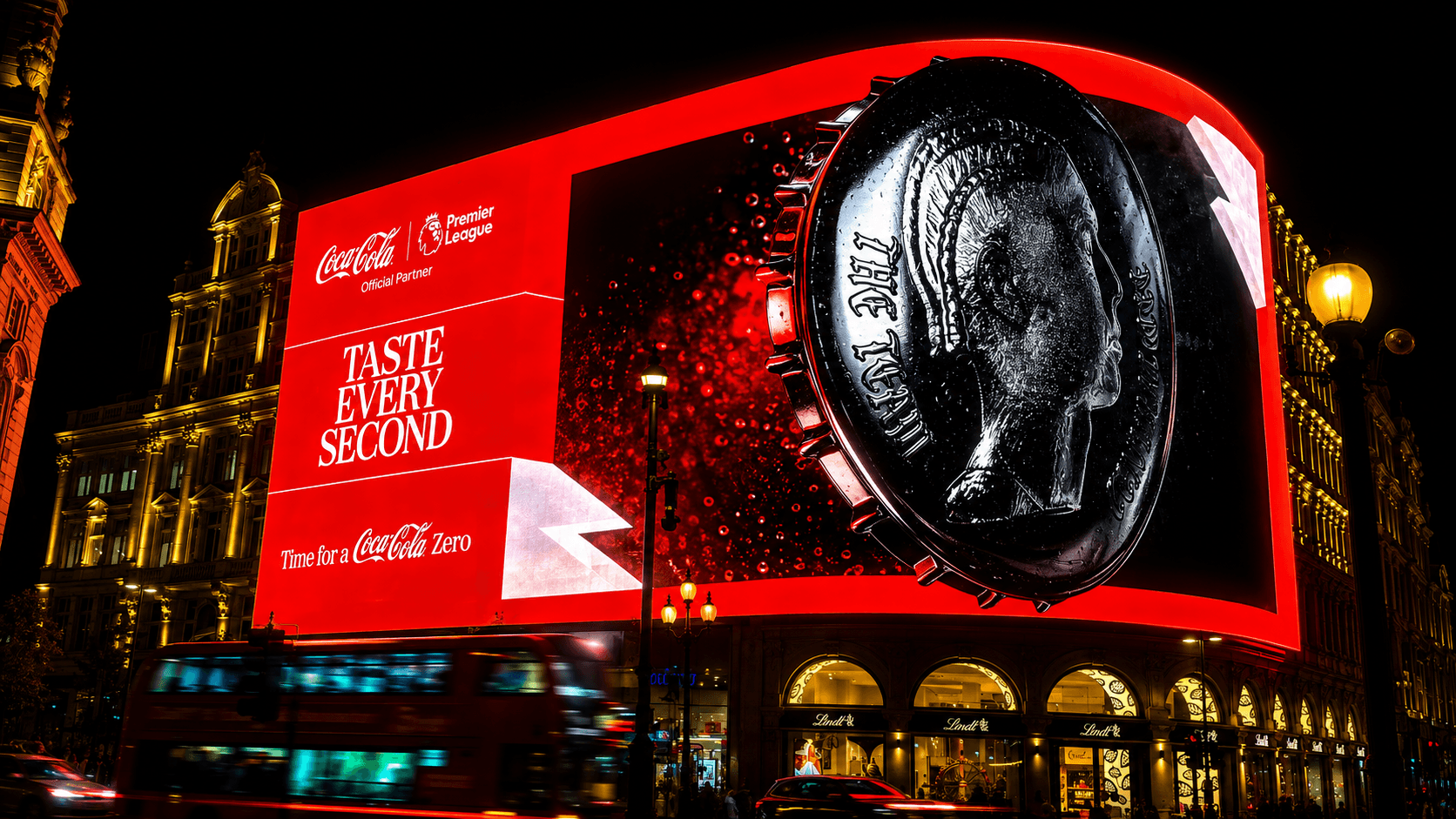
We spend a lot of time looking down.
Whether it’s at our phones, at our feeds, or at whatever happens to be competing for our attention in that particular moment.
The best digital out-of-home advertising does the opposite. It gives you a reason to look up.
That might be through scale, movement, 3D, a clever use of its surroundings or simply an idea that feels impossible to ignore.
But as the way we consume content continues to evolve, what does it take for DOOH to keep commanding that attention?
DOOH still matters
Few places offer a better proof of this than Piccadilly Lights.
New research from Truth Consulting found that appearing on Piccadilly Lights can account for more than a third of a campaign’s organic digital impressions.
In a single month, content captured on the display can also generate up to 139 million organic social impressions across as many as 107 countries.
Coca-Cola is perhaps one of the clearest examples of its impact. The brand has had a presence at Piccadilly Circus since 1954, and that long-standing association continues to pay off. According to the study, Coca-Cola receives twice the “brand halo” of an average campaign on the site.
We’ve seen what goes into creating for that space first-hand. Across 2026, Pixelworx has worked on three Coca-Cola DOOH projects for Piccadilly Lights, including campaigns with FIFA and Premier League.
For Coca-Cola x Premier League’s "Taste Every Second" campaign, that meant taking an existing 2D creative and rebuilding it in 3D for Piccadilly’s DeepScreen format. Rather than simply scaling the original work up, we had to rethink how its elements could use the depth, perspective and scale of the screen itself.
And the possibilities of what can be created are about to get even bigger.
Piccadilly Lights is Changing
Even for a stage like Piccadilly Lights, staying relevant means continuing to evolve around what brands want to create and what audiences will actually stop and notice.
Ocean Outdoor UK CEO Nick Shaw says feedback from clients has been clear: “they want more domination time.” And, as he puts it, “domination time equals more creativity.”
So, from January 2027, Piccadilly Lights is changing:
More full-screen time: one 40-second takeover per hour will become two 60-second takeovers per hour.
One much bigger canvas: brands will be able to use the entire 783.5-square-metre display as one canvas, creating more freedom for large-scale creative and 3D DeepScreen work.
Simpler production requirements: standardised formats will mean fewer versions and files need to be created and delivered.
More connection between screen and experience: brands using Piccadilly Lights alongside The Venue, the physical event space directly beneath it, will be able to keep part of the screen dedicated to their brand while the surrounding advertising continues to rotate.
In other words, the screen is giving brands more room to experiment, while removing some of the production restrictions that previously dictated what could be made.
So, what does this mean for DOOH?
Piccadilly Lights is one of the most recognisable outdoor advertising sites in the world, and the direction it is moving reflects many of the opportunities opening up across DOOH more broadly.
Bigger canvases. Fewer restrictions. More immersive and creative. Greater integration between physical and digital experiences. And content designed not just to be seen in the street, but to travel far beyond it.
But however much DOOH evolves, one core thing has to remain true. If you’re going to persuade someone to stop scrolling and look up, you need to give them something worth looking at.
Related:
See how we transformed Coca-Cola x Premier League’s “Taste Every Second” campaign for the Piccadilly Lights Screen.

